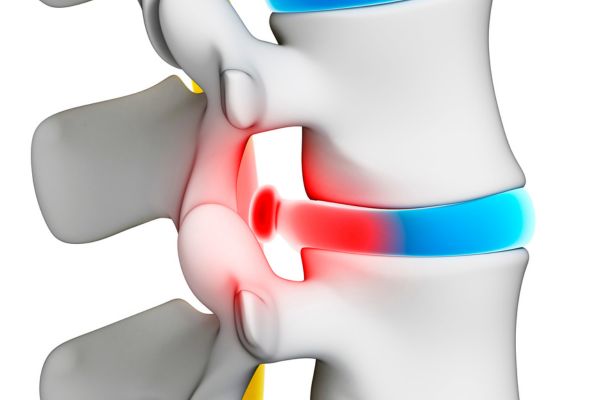
A herniated disc develops when disc material extends beyond its normal boundary. Depending on its location, it may irritate nearby nerves and cause back pain, numbness, tingling, weakness, or pain extending into an arm or leg.
Interest in stem cell therapy for herniated disc has increased as researchers investigate biological treatments for damaged spinal discs. However, much of the available human research focuses on degenerative disc disease rather than herniation specifically. This distinction is important when evaluating evidence, candidacy, and realistic outcomes.
How Does a Herniated Disc Cause Symptoms?
The potential role of stem cell therapy for herniated disc becomes clearer when the source of symptoms is identified. Intervertebral discs cushion the vertebrae and help distribute loads across the spine.
A disc has a softer center surrounded by a stronger outer layer. When disc material moves beyond its normal position, nearby nerve roots may become irritated or compressed. Inflammation around affected tissues can also contribute to pain.
Not every herniation seen on diagnostic imaging causes symptoms. MRI findings therefore need to correspond with the location of pain, neurological symptoms, physical examination, and functional limitations.
When the compressed nerve is the sciatic nerve, the first question is normally how long sciatica usually lasts.
Stem Cell Therapy for Herniated Disc: What Is Being Studied?
Research on stem cell therapy for herniated disc is connected mainly to studies of intervertebral disc degeneration. Scientists have investigated whether mesenchymal stem or stromal cells could influence the biological environment within degenerating discs.
Research has examined potential effects involving inflammation, cellular activity, and extracellular matrix production. These proposed mechanisms should not be confused with physically correcting a herniation.
A cellular treatment cannot simply reposition displaced disc material. Research also has not established predictable regeneration of a herniated disc.
People investigating stem cell therapy in Colombia should ask whether evidence supporting a proposed treatment relates specifically to their spinal diagnosis rather than another form of disc disease.
What Does Current Research Tell Patients?
Evidence for stem cell therapy for herniated disc remains limited. Clinical trials of intradiscal cell therapies have predominantly involved people with degenerative disc disease or discogenic low-back pain.
Some studies have reported improvements in pain or function. However, these findings do not prove that cellular therapy repairs displaced disc material or reverses nerve compression caused by a herniation.
The FDA states that regenerative medicine products are not approved in the United States for orthopedic conditions such as disc disease or back pain. Claims of guaranteed regeneration, permanent pain relief, or predictable recovery should therefore be treated cautiously.
At Stem Cell Medellín, discussions about regenerative care should be based on the individual clinical problem and available evidence rather than assuming all disc conditions respond similarly.
Who Might Be an Appropriate Candidate?
Determining candidacy for stem cell therapy for herniated disc requires more information than an MRI diagnosis. The clinical importance of the herniation must first be established.
Assessment may consider:
- Location and extent of the herniation
- Degree of disc degeneration
- Nerve involvement
- Pain pattern and duration
- Numbness or weakness
- Previous treatment response
- Functional limitations
- Overall medical history
These factors help distinguish patients with primarily degenerative disc-related pain from those whose symptoms may result from substantial mechanical nerve compression.
Progressive weakness or other important neurological changes may require a different treatment pathway. Appropriate patient selection therefore includes recognizing when regenerative care may not address the primary problem.
What Are the Important Treatment Limitations?
Realistic expectations are particularly important with stem cell therapy for herniated disc. Biological treatment and mechanical decompression address different aspects of spinal disease.
Cell-based therapies are being investigated for potential effects on degenerative tissue. They do not physically remove disc material pressing against a nerve. A biological response therefore should not be assumed to resolve significant mechanical compression.
Regenerative therapy also cannot guarantee that a patient will avoid surgery or experience lasting pain relief.
A responsible discussion should define the intended outcome. Reducing pain, improving function, influencing inflammation, restoring disc tissue, and relieving nerve compression are separate clinical goals. Evidence supporting one outcome does not automatically establish the others.
Why Do Imaging and Clinical Assessment Matter?
Before stem cell therapy for herniated disc is considered, imaging findings need to be connected with the patient’s symptoms.
MRI can show the location of a herniation, disc degeneration, and its relationship with nearby nerves. Clinical examination provides additional information about strength, sensation, pain distribution, and mobility.
At Stem Cell Medellín, Dr. Catalina Henao has training in regenerative medicine. Her clinical background is relevant when regenerative options and individualized treatment planning are being assessed.
Importantly, assessment may also show that another form of care deserves priority. Regenerative medicine should not delay appropriate conventional management when significant neurological involvement is present.
How Does Regenerative Care Fit With Other Treatments?
Considering stem cell therapy for herniated disc does not mean established treatments become irrelevant. Many herniated discs are initially managed without surgery.
Depending on the clinical situation, herniated disc treatment may involve appropriate activity, physical therapy, rehabilitation, medications, or other conservative approaches.
Surgical evaluation may be necessary in selected cases, especially when persistent nerve compression causes significant or worsening neurological problems.
Regenerative care has a different objective. Cellular approaches are being studied for biological effects within disc tissue, while certain surgical procedures directly address mechanical compression. Treatment selection should therefore match the actual source and severity of symptoms.
Making an Informed Treatment Decision
Before choosing stem cell therapy for herniated disc, patients should ask what tissue is being targeted, what evidence applies to their diagnosis, what improvement is realistically expected, and what alternatives are available.
Current research supports continued investigation of cellular therapies for degenerative disc conditions, but it does not establish stem cells as a universal solution for herniated discs.
The most appropriate decision depends on how symptoms, neurological findings, diagnostic imaging, previous treatments, and treatment goals fit together. A regenerative option should be considered because it makes clinical sense for a particular patient—not simply because a herniated disc appears on an MRI.
FAQs
Can stem cell therapy for herniated disc repair the disc?
Current evidence does not show that cellular treatment can reliably restore a herniated disc to its original structure. Most clinical research has focused on degenerative disc disease rather than proving structural repair of herniations.
Can stem cells remove nerve compression?
No. Cell-based treatment does not physically remove displaced disc material pressing against a nerve. Significant or worsening nerve compression may require conventional spine treatment or specialist assessment.
Does every herniated disc require surgery?
No. Many cases are treated conservatively. The appropriate approach depends on symptoms, neurological findings, imaging, functional limitations, and response to previous non-surgical care.
How does Stem Cell Medellín assess candidacy?
Stem Cell Medellín considers factors such as symptoms, medical history, imaging findings, neurological involvement, previous treatments, and treatment goals. A herniated disc diagnosis by itself does not establish suitability.
What should I ask before regenerative treatment?
Ask about the proposed cellular product, intended treatment target, supporting evidence, potential risks, realistic outcomes, limitations, and alternatives. These questions help distinguish evidence-based expectations from unsupported treatment claims.
Explore Our Regenerative Treatments in Medellin
- Stem Cells in Colombia: 2026 Guide for International Patients
- Stem Cell Therapy Prices by Dose
- Knee Pain Stem Cell Therapy
- Joint Pain Stem Cell Therapy
- Back Pain Stem Cell Therapy
- Shoulder & Rotator Cuff Stem Cell Therapy
- Hip Pain Stem Cell Therapy
- Sports Injury Stem Cell Therapy
- Longevity & Anti-Aging Therapy
- Meet Dr. Catalina Henao