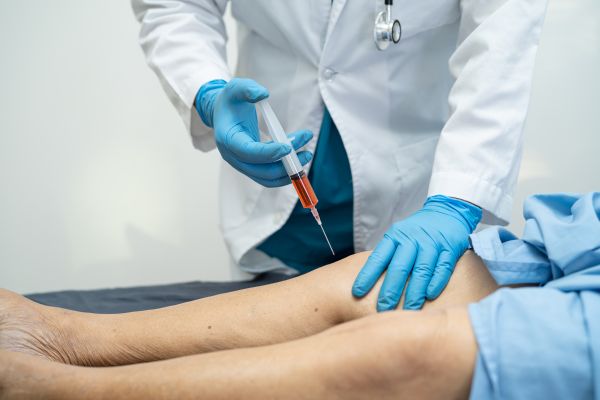
The knee contains cartilage, bone, ligaments, menisci, tendons, and synovial tissue working together to support movement. Damage can affect these structures in different ways, so regenerative treatment cannot be approached as one solution for every knee condition.
Research into stem cell therapy for knees has focused particularly on knee osteoarthritis and degenerative joint changes. Studies suggest potential benefits for selected patients, but evidence varies according to the cellular product, treatment protocol, disease severity, and outcome being measured. Understanding these differences is essential before considering treatment.
Stem Cell Therapy for Knees: What Is Being Studied?
Research on stem cell therapy for knees frequently involves mesenchymal stem or stromal cells. Scientists are investigating how these cells and their biological activity may influence the environment within an affected joint.
The proposed mechanism is more complex than simply injecting cells that become new cartilage. Research has examined potential effects on inflammatory signaling, tissue interactions, and processes involved in joint degeneration.
Clinical studies have reported improvements in measures such as pain and physical function among some people with knee osteoarthritis. However, differences in cell sources, doses, preparation methods, and follow-up periods make direct comparisons difficult.
Therefore, promising results should not be interpreted as proof that cell-based therapy consistently restores damaged knee structures.
Which Knee Conditions Are Relevant?
A broad discussion of stem cell therapy for knees must distinguish between different knee disorders rather than treating knee pain as a diagnosis.
Knee osteoarthritis has received substantial attention in regenerative medicine research. The condition involves changes throughout the joint, including cartilage deterioration and alterations in bone and synovial tissue.
Other knee problems may involve cartilage defects, meniscal damage, ligament injuries, or previous trauma. These conditions have different biological and mechanical characteristics.
Evidence supporting one application cannot automatically be transferred to another. Someone researching regenerative treatment in Medellín should therefore ask whether the proposed treatment has meaningful evidence for their specific knee diagnosis.
Two questions come up constantly before any knee consultation: whether a meniscus tear can heal without surgery and whether a torn ACL can heal on its own. In both cases the answer depends on the location and grade of the tear, which is why imaging comes before any treatment decision.
What Does Current Evidence Show?
The evidence for stem cell therapy for knees is developing rather than definitive. Randomized trials and systematic reviews have reported possible improvements in pain and function among selected patients with knee osteoarthritis.
However, research remains heterogeneous. Studies may use cells derived from bone marrow, adipose tissue, umbilical tissue, or other sources. Preparation methods, doses, comparison treatments, and outcome measures also vary.
These differences make “stem cell treatment” a broad category rather than a single standardized therapy.
Another important distinction concerns clinical versus structural outcomes. Improved mobility or reduced symptoms does not prove that cartilage has regenerated. Current evidence does not support promises of complete cartilage restoration or reversal of osteoarthritis.
Who May Be Considered a Candidate?
Candidacy for stem cell therapy for knees depends on the condition of the entire joint, not simply the presence of discomfort.
Factors that may influence patient selection include:
- Specific knee diagnosis
- Degree of joint degeneration
- Cartilage and bone changes
- Joint alignment and stability
- Previous injuries or surgery
- Functional limitations
- Response to earlier treatments
- General medical health
Diagnostic imaging can add important information. X-rays may reveal joint-space narrowing and bone changes, while MRI can provide more detail about cartilage, menisci, ligaments, and surrounding tissues.
At Stem Cell Medellín, these findings can help place regenerative treatment within the patient’s wider clinical picture rather than assuming everyone with a knee disorder is a candidate.
What Outcomes Are Realistic?
Expectations surrounding stem cell therapy for knees should distinguish symptom improvement from biological regeneration.
Clinical research may measure pain, mobility, physical function, quality of life, or structural changes. These outcomes are related but not interchangeable.
A person might experience better function without evidence that lost cartilage has been completely restored. Similarly, an imaging change does not automatically mean everyday mobility has improved.
For this reason, regenerative care should not be presented as guaranteed cartilage regrowth, permanent symptom relief, or a certain way to avoid future surgery.
Treatment goals should instead be defined according to the diagnosis, current evidence, joint condition, and outcomes that are meaningful for the individual patient.
Why Does Orthopedic Assessment Matter?
Before stem cell therapy for knees is considered, orthopedic assessment can clarify which structures are affected and whether mechanical factors influence the condition.
Examination may evaluate joint stability, alignment, range of motion, strength, swelling, and functional limitations. Imaging provides additional anatomical information.
This distinction matters because advanced joint destruction, substantial instability, or other structural problems may require treatment strategies that regenerative medicine cannot address directly.
Stem Cell Medellín identifies Dr. CHAO within its medical team in an orthopedic context. Orthopedic input can help determine where regenerative options fit among available treatments without assuming they should replace established care.
Where Does Regenerative Medicine Fit in Knee Care?
Considering stem cell therapy for knees requires comparing it with the broader knee treatment landscape.
Depending on the diagnosis and severity, management may include rehabilitation, exercise, physical therapy, medications, conventional injections, activity modification, or surgical options. Different approaches address different aspects of joint disease.
Regenerative medicine is being investigated for its biological effects and should not automatically be positioned as a replacement for these treatments.
Regulatory status also requires clarity. The FDA states that regenerative medicine products are not approved in the United States for orthopedic conditions including osteoarthritis and knee pain.
Patients receiving care internationally should separately consider local regulations, treatment evidence, physician oversight, and informed consent.
Making an Informed Knee Treatment Decision
Research into stem cell therapy for knees continues to expand, but patients should look beyond the general treatment label.
Important questions include which cellular product is being proposed, which knee structure or disease process is being targeted, what evidence supports that application, and what outcome can reasonably be expected.
A broad knee treatment decision should integrate diagnosis, joint anatomy, disease severity, function, scientific evidence, and reasonable alternatives. This approach keeps regenerative medicine in proper clinical context rather than reducing a complex knee condition to a single symptom or procedure.
FAQs
Can stem cells rebuild knee cartilage?
Current research does not establish predictable, complete cartilage restoration. Some studies investigate structural changes, but improvements in symptoms or function should not automatically be interpreted as evidence that damaged cartilage has regenerated.
Which knee conditions are studied in regenerative medicine?
Knee osteoarthritis has received the most attention in cell-based clinical research. Other knee tissues and injuries are also being investigated, but evidence varies considerably according to the condition and treatment used.
Is stem cell therapy for knees FDA approved?
No regenerative medicine products are FDA-approved in the United States for orthopedic conditions such as osteoarthritis or knee pain. Treatment availability or ongoing research should not be confused with FDA approval.
How does Stem Cell Medellín determine candidacy?
Stem Cell Medellín can consider diagnosis, joint condition, imaging findings, previous treatments, medical history, functional limitations, and treatment goals when determining whether regenerative care may be relevant.
Is regenerative treatment appropriate for every knee condition?
No. Knee disorders can involve cartilage, bone, ligaments, menisci, or several structures simultaneously. Treatment suitability depends on the diagnosis, severity, structural findings, available evidence, and individual clinical circumstances.
Explore Our Regenerative Treatments in Medellin
- Stem Cells in Colombia: 2026 Guide for International Patients
- Stem Cell Therapy Prices by Dose
- Knee Pain Stem Cell Therapy
- Joint Pain Stem Cell Therapy
- Back Pain Stem Cell Therapy
- Shoulder & Rotator Cuff Stem Cell Therapy
- Hip Pain Stem Cell Therapy
- Sports Injury Stem Cell Therapy
- Longevity & Anti-Aging Therapy
- Meet Dr. Catalina Henao